Diamond cuts come in many forms, each offering its own character, symbolism and radiance. They shape presence, proportion and the way a ring is experienced on the hand. Some cuts are classic and familiar, while others are designed to catch the eye. The marquise belongs firmly in the latter, standing apart with an instantly recognizable dramatic silhouette.
A marquise engagement ring brings together history, artistry and presence. Its elongated form, defined points and flowing curves create an expressive and refined diamond that immediately draws the eye. Let’s understand what makes this fancy cut so special.
History of the marquise cut
The marquise cut traces its origins to 18th-century France. The cut was commissioned by King Louis XV, who requested that the diamond be designed to resemble the smile of his beloved, the Marquise de Pompadour. This romantic beginning gave the cut its name and established its association with elegance and admiration.
Originally known as the navette cut due to its boat-like shape, the marquise quickly became popular among the European aristocracy. Its elongated form was prized for its ability to maximize perceived size, making it an impressive choice at a time when diamond cutting techniques were still evolving.
The marquise diamond cut has long been associated with royalty and refinement, admired in regal circles for centuries before gaining popularity among the general public in the late 1960s and early 1970s. As its presence in bridal jewelry became more widespread, the cut eventually came to be seen as traditional, leading a new generation to look elsewhere. Today, that perception has shifted. Modern shoppers are rediscovering the marquise cut, drawn to its distinctive shape and historic charm.
The symbolism of the marquise cut
The marquise cut carries symbolism rooted in romance and strength. Its pointed ends suggest direction, purpose and clarity, while its curved sides soften the shape, creating balance and harmony. The shape is associated with royalty, passion, confidence and individuality.
The elongated outline is often linked with ambition and forward movement, making it a meaningful symbol of a shared future when set in an engagement ring. Choosing a marquise engagement ring reflects a desire to celebrate a love that is distinctive, expressive, and deeply rooted in history.
The marquise cut is defined by its slender body and two pointed ends, typically featuring 56-58 facets. When expertly crafted, these facets are arranged to maximize light return, creating excellent sparkle.
The cut is one of the defining factors of a diamond. Traditionally, a marquise cut features 33 facets on the crown and 25 on the pavilion, carefully arranged to support brilliance while preserving the diamond's elongated profile.
Today, most marquise diamonds are cut to length-to-width ratios ranging from 1:1.75 to 2.25. The most proportional and ideal ratio is 2.0. Those measuring between 1.75 - 1.85 look shorter and wider in appearance, whereas a ratio of 2.1 - 2.2 appears longer and leaner. Symmetry and proportion are defining characteristics of a well-cut marquise diamond. The stone must be balanced, as a cut that is too long can appear narrow, and one that is too short may look squat and lose its elegance. For further information on the factors defining the structure of the diamond, you can refer to our guide.
The ideal depth for this shape is between 58% and 62%, while the ideal table range is 53% to 63%.
Understanding the appearance of a marquise engagement ring
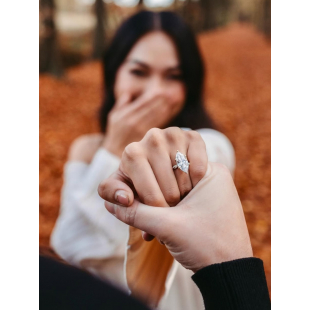
One of the most compelling qualities of a marquise engagement ring is its visual presence. The elongated shape creates a larger surface area, allowing the diamond to appear larger than its carat weight; even a 0.36-carat stone can reach an impressive length of around 7mm.
This effect is further enhanced by the way the marquise sits on the finger, drawing the eye along its length. The shape can help the finger look slender and longer, making it a recommended cut for those with smaller hands.
The cut maintains a timeless appeal in vintage-inspired designs and contemporary charm when reimagined in modern designs, and adapts beautifully to a wide range of styles. In a solitaire setting, the diamond's dramatic outline takes center stage, allowing its shape and brilliance to shine. Set north to south, it elongates the finger and creates a classic, refined look. For a modern approach, marquise diamonds can also be set east-west, creating a distinct look.
Halo designs amplify the marquise's presence, surrounding it with a delicate frame of diamonds that enhance its curves and points. In trilogy settings, the marquise works strikingly as a center stone, paired with side stones in the same cut or pear-shaped for balance and contrast. Vintage-inspired designs highlight the cut's historic roots, incorporating intricate metalwork, milgrain detailing and ornate galleries.
Stylish designs like our Rosalie accentuate this cut's beauty. The central stone is held in a six-prong setting and surrounded by three petal structures that continue in a beautifully twisted band. The band forms by interlinking two delicate strands, one with studded diamonds and the other plain, creating a balanced look. The entire composition makes the ring look like a miniature crown, linking it to the marquise cut's royal history. Such engagement rings instantly stand out when making a choice.
The marquise cut remains unique for its graceful balance of history and beauty. It reflects light distinctively, appears larger than its carat weight, and carries symbolism rooted in romance and individuality.
At Austen & Blake, every marquise diamond is selected for balance, brilliance and proportion. Crafted to order and designed with care. Every ring we make celebrates the beauty of this exceptional cut, creating pieces that are meaningful today and will be for generations to come.


 link copied




 Request a virtual appointment

Diamond cuts come in many forms, each offering its own character, symbolism and radiance. They shape presence, proportion and the way a ring is experienced on the hand. Some cuts are classic and familiar, while others are designed to catch the eye. The marquise belongs firmly in the latter, standing apart with an instantly recognizable dramatic silhouette.
A marquise engagement ring brings together history, artistry and presence. Its elongated form, defined points and flowing curves create an expressive and refined diamond that immediately draws the eye. Let’s understand what makes this fancy cut so special.
History of the marquise cut
The marquise cut traces its origins to 18th-century France. The cut was commissioned by King Louis XV, who requested that the diamond be designed to resemble the smile of his beloved, the Marquise de Pompadour. This romantic beginning gave the cut its name and established its association with elegance and admiration.
Originally known as the navette cut due to its boat-like shape, the marquise quickly became popular among the European aristocracy. Its elongated form was prized for its ability to maximize perceived size, making it an impressive choice at a time when diamond cutting techniques were still evolving.
The marquise diamond cut has long been associated with royalty and refinement, admired in regal circles for centuries before gaining popularity among the general public in the late 1960s and early 1970s. As its presence in bridal jewelry became more widespread, the cut eventually came to be seen as traditional, leading a new generation to look elsewhere. Today, that perception has shifted. Modern shoppers are rediscovering the marquise cut, drawn to its distinctive shape and historic charm.
The symbolism of the marquise cut
The marquise cut carries symbolism rooted in romance and strength. Its pointed ends suggest direction, purpose and clarity, while its curved sides soften the shape, creating balance and harmony. The shape is associated with royalty, passion, confidence and individuality.
The elongated outline is often linked with ambition and forward movement, making it a meaningful symbol of a shared future when set in an engagement ring. Choosing a marquise engagement ring reflects a desire to celebrate a love that is distinctive, expressive, and deeply rooted in history.
The structure of the marquise cut
The marquise cut is defined by its slender body and two pointed ends, typically featuring 56-58 facets. When expertly crafted, these facets are arranged to maximize light return, creating excellent sparkle.
The cut is one of the defining factors of a diamond. Traditionally, a marquise cut features 33 facets on the crown and 25 on the pavilion, carefully arranged to support brilliance while preserving the diamond's elongated profile.
Today, most marquise diamonds are cut to length-to-width ratios ranging from 1:1.75 to 2.25. The most proportional and ideal ratio is 2.0. Those measuring between 1.75 - 1.85 look shorter and wider in appearance, whereas a ratio of 2.1 - 2.2 appears longer and leaner. Symmetry and proportion are defining characteristics of a well-cut marquise diamond. The stone must be balanced, as a cut that is too long can appear narrow, and one that is too short may look squat and lose its elegance. For further information on the factors defining the structure of the diamond, you can refer to our guide.
The ideal depth for this shape is between 58% and 62%, while the ideal table range is 53% to 63%.
Understanding the appearance of a marquise engagement ring
One of the most compelling qualities of a marquise engagement ring is its visual presence. The elongated shape creates a larger surface area, allowing the diamond to appear larger than its carat weight; even a 0.36-carat stone can reach an impressive length of around 7mm.
This effect is further enhanced by the way the marquise sits on the finger, drawing the eye along its length. The shape can help the finger look slender and longer, making it a recommended cut for those with smaller hands.
Design options for marquise engagement rings
The cut maintains a timeless appeal in vintage-inspired designs and contemporary charm when reimagined in modern designs, and adapts beautifully to a wide range of styles. In a solitaire setting, the diamond's dramatic outline takes center stage, allowing its shape and brilliance to shine. Set north to south, it elongates the finger and creates a classic, refined look. For a modern approach, marquise diamonds can also be set east-west, creating a distinct look.
Halo designs amplify the marquise's presence, surrounding it with a delicate frame of diamonds that enhance its curves and points. In trilogy settings, the marquise works strikingly as a center stone, paired with side stones in the same cut or pear-shaped for balance and contrast. Vintage-inspired designs highlight the cut's historic roots, incorporating intricate metalwork, milgrain detailing and ornate galleries.
Stylish designs like our Rosalie accentuate this cut's beauty. The central stone is held in a six-prong setting and surrounded by three petal structures that continue in a beautifully twisted band. The band forms by interlinking two delicate strands, one with studded diamonds and the other plain, creating a balanced look. The entire composition makes the ring look like a miniature crown, linking it to the marquise cut's royal history. Such engagement rings instantly stand out when making a choice.
The enduring appeal of the marquise cut
The marquise cut remains unique for its graceful balance of history and beauty. It reflects light distinctively, appears larger than its carat weight, and carries symbolism rooted in romance and individuality.
At Austen & Blake, every marquise diamond is selected for balance, brilliance and proportion. Crafted to order and designed with care. Every ring we make celebrates the beauty of this exceptional cut, creating pieces that are meaningful today and will be for generations to come.